

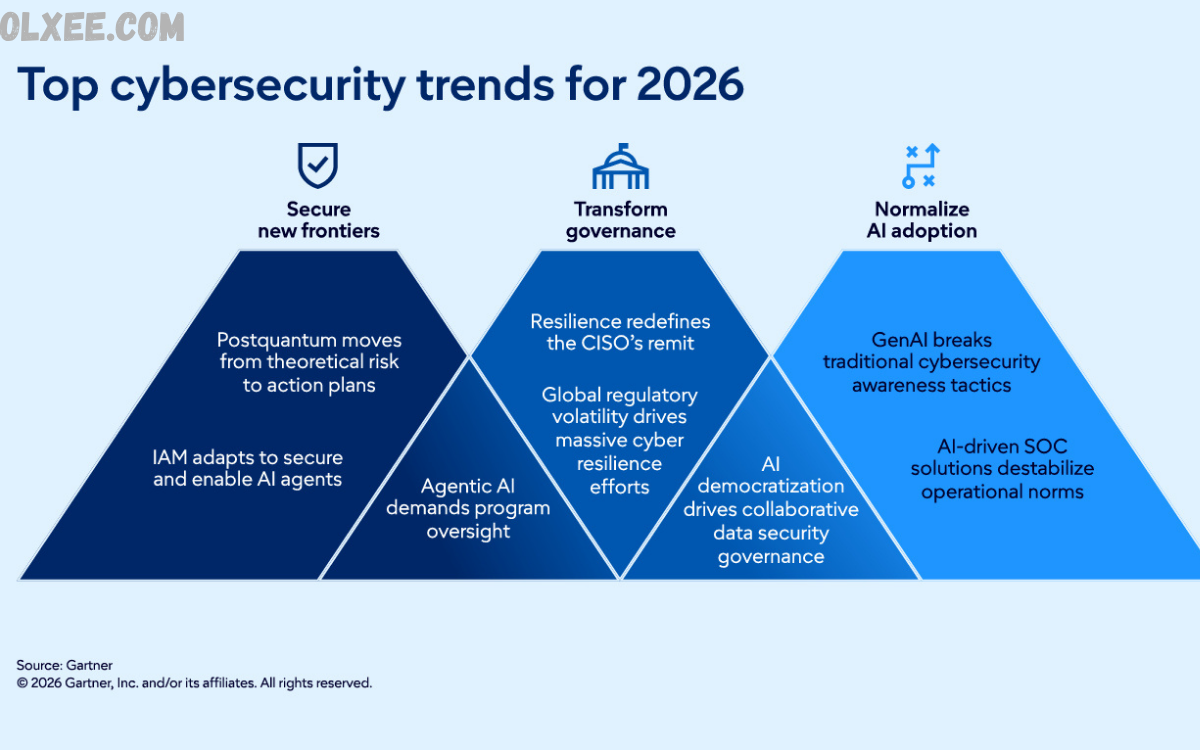
Cybersecurity Trends 2026 are shaping the future of digital transformation as organizations, governments, and individuals face increasingly sophisticated cyber threats. With artificial intelligence, cloud computing, remote work, and connected devices becoming standard across industries, cybersecurity has evolved from a technical necessity into a strategic business priority.
The cybersecurity landscape in 2026 is defined by intelligent automation, predictive threat detection, Zero Trust architecture, cloud-native security, quantum-resistant encryption, and proactive risk management.
The Rise of AI-Powered Cybersecurity
Artificial Intelligence has become one of the most influential cybersecurity trends for 2026. Organizations increasingly rely on AI-driven security platforms to identify suspicious behavior, detect anomalies, automate incident response, and reduce response times.
Machine learning algorithms continuously analyze network traffic, user behavior, and endpoint activity to identify threats before they escalate into serious security incidents. Unlike traditional security systems, AI adapts to evolving attack patterns, making it significantly more effective against modern cyber threats.
Zero Trust Security Becomes the Standard
Zero Trust architecture continues to dominate Cybersecurity Trends 2026 as organizations abandon traditional perimeter-based security models.
The Zero Trust approach follows the principle of “Never Trust, Always Verify.” Every user, device, application, and network request must be authenticated, authorized, and continuously validated before access is granted.
Key components of Zero Trust include:
- Multi-factor authentication
- Identity verification
- Least privilege access
- Continuous monitoring
- Micro-segmentation
- Device compliance validation
Organizations implementing Zero Trust significantly reduce the risk of unauthorized access and insider threats.
Cloud Security Takes Center Stage
Cloud computing continues to expand rapidly, making cloud security one of the most important cybersecurity trends of 2026.
Businesses increasingly operate across hybrid and multi-cloud environments, creating new security challenges. Cloud misconfigurations remain one of the leading causes of data breaches.
Modern cloud security focuses on:
- Cloud workload protection
- Cloud Security Posture Management (CSPM)
- Cloud-native application protection
- Secure APIs
- Identity and access management
- Continuous cloud monitoring
Organizations are adopting automated cloud security tools that continuously identify vulnerabilities and enforce security policies across cloud environments.
Ransomware Defense Evolves
Ransomware remains one of the most damaging cyber threats in 2026. Criminal organizations continue targeting healthcare providers, financial institutions, government agencies, manufacturers, and educational organizations.
Modern ransomware attacks involve:
- Double extortion
- Triple extortion
- Data theft
- Encryption of critical systems
- Supply chain infiltration
Organizations are responding by implementing:
- Immutable backups
- Endpoint Detection and Response (EDR)
- Extended Detection and Response (XDR)
- Security awareness training
- Threat intelligence platforms
- Incident response planning
Rapid recovery capabilities have become just as important as preventing ransomware infections.
Read Also: Future Technology Trends to Watch in 2026
Cybersecurity Mesh Architecture Gains Momentum
Cybersecurity Mesh Architecture (CSMA) is emerging as one of the defining cybersecurity trends of 2026.
Rather than relying on centralized security infrastructure, cybersecurity mesh distributes security controls across users, devices, applications, and cloud services.
Benefits include:
- Better scalability
- Improved flexibility
- Stronger identity management
- Unified security policies
- Enhanced visibility
- Faster threat response
Cybersecurity mesh supports modern organizations operating in decentralized and hybrid work environments.
Quantum-Resistant Encryption
As quantum computing advances, traditional encryption methods face future risks.
Cybersecurity Trends 2026 include significant investment in quantum-safe cryptography to protect sensitive information against future quantum attacks.
Organizations handling financial records, healthcare information, government data, and intellectual property are preparing migration strategies toward post-quantum encryption algorithms.
Although large-scale quantum attacks remain in development, proactive organizations are planning today to ensure long-term data protection.
Supply Chain Security Becomes Critical
Third-party vendors have become attractive targets for cybercriminals.
Supply chain attacks allow attackers to compromise multiple organizations through a single trusted vendor.
Organizations now perform extensive security assessments before partnering with suppliers.
Supply chain security includes:
- Vendor risk management
- Continuous monitoring
- Software Bill of Materials (SBOM)
- Third-party security audits
- Secure software development
- API security
Organizations recognize that cybersecurity extends beyond their internal infrastructure.
Identity Security Leads Modern Defense
Identity has become the new security perimeter.
Identity-based attacks continue to increase as attackers steal credentials using phishing, malware, credential stuffing, and social engineering.
Modern identity security includes:
- Passwordless authentication
- Biometric verification
- Adaptive authentication
- Risk-based authentication
- Identity governance
- Privileged Access Management (PAM)
Strong identity security significantly reduces unauthorized access and account compromise.
AI-Generated Phishing Attacks Increase
One of the fastest-growing Cybersecurity Trends 2026 involves AI-generated phishing campaigns.
Generative AI enables attackers to produce highly personalized emails, fake websites, realistic voice cloning, and convincing business communications.
Traditional phishing detection methods struggle against these sophisticated attacks.
Organizations now rely on:
- AI-powered email security
- User behavior analytics
- Employee awareness training
- Secure communication verification
- Advanced threat detection
Human awareness remains one of the strongest defenses against phishing attacks.
Extended Detection and Response (XDR)
Security teams increasingly deploy XDR platforms to improve threat visibility.
Unlike traditional endpoint protection, XDR integrates security data from:
- Endpoints
- Networks
- Cloud environments
- Identity systems
- Email security
- Applications
Centralized analysis enables security teams to detect coordinated attacks faster while reducing alert fatigue.
XDR is becoming a core component of enterprise cybersecurity strategies.
Security Automation Expands
Organizations struggle with growing numbers of security alerts and limited cybersecurity professionals.
Automation addresses this challenge by performing repetitive security tasks automatically.
Security automation includes:
- Incident response
- Threat hunting
- Vulnerability scanning
- Compliance reporting
- Malware isolation
- User access reviews
Automation allows security teams to focus on complex investigations and strategic improvements.
Internet of Things Security
Billions of connected devices continue to expand the cyber attack surface.
IoT security remains one of the fastest-growing Cybersecurity Trends 2026 due to increasing adoption across manufacturing, healthcare, transportation, retail, and smart cities.
Organizations improve IoT security through:
- Device authentication
- Secure firmware updates
- Network segmentation
- Continuous monitoring
- Device lifecycle management
- Encryption
Proper IoT governance reduces vulnerabilities associated with connected devices.
Regulatory Compliance Continues to Evolve
Governments worldwide continue strengthening cybersecurity regulations.
Organizations must comply with industry-specific security standards covering:
- Data privacy
- Incident reporting
- Risk assessments
- Encryption
- Access controls
- Vendor security
Compliance is no longer viewed solely as a legal obligation but as an essential component of enterprise risk management.
Human-Centered Cybersecurity
Technology alone cannot eliminate cyber risks.
Employees remain both the greatest vulnerability and one of the strongest security assets.
Organizations increasingly invest in:
- Security awareness training
- Phishing simulations
- Cyber hygiene education
- Insider threat prevention
- Executive security programs
- Security culture initiatives
Continuing education significantly reduces the success of cyberattacks.
Privacy-Enhancing Technologies
Privacy continues to become a competitive business advantage.
Organizations increasingly adopt Privacy-Enhancing Technologies (PETs), including:
- Differential privacy
- Homomorphic encryption
- Secure multi-party computation
- Data anonymization
- Confidential computing
These technologies enable organizations to process sensitive data while minimizing privacy risks.
Cybersecurity Talent Shortage
Despite technological advances, the cybersecurity workforce shortage remains a major challenge.
Organizations address this issue by:
- Upskilling existing employees
- Investing in automation
- Outsourcing specialized services
- Using managed security providers
- Implementing AI-assisted security operations
Developing cybersecurity talent remains essential for long-term resilience.
Future Outlook
Cybersecurity Trends 2026 indicate that security will become increasingly predictive, automated, and intelligence-driven. Artificial intelligence, behavioral analytics, quantum-resistant encryption, cloud-native protection, and Zero Trust frameworks will define the next generation of cybersecurity.
Organizations that invest in proactive security strategies, continuous monitoring, employee education, and resilient infrastructure will be better positioned to defend against evolving cyber threats.
Frequently Asked Questions
What are Cybersecurity Trends 2026?
Cybersecurity Trends 2026 refer to the latest technologies, strategies, and best practices organizations use to protect digital assets against evolving cyber threats, including AI-powered attacks, ransomware, cloud vulnerabilities, and identity-based risks.
Why is Zero Trust important in 2026?
Zero Trust is important because it continuously verifies every user, device, and application before granting access, reducing the risk of unauthorized access and minimizing the impact of cyberattacks.
How is artificial intelligence improving cybersecurity?
Artificial intelligence enhances cybersecurity by detecting threats faster, analyzing large volumes of security data, automating incident response, identifying unusual behavior, and helping security teams respond more efficiently to attacks.
What is the biggest cybersecurity threat in 2026?
Ransomware remains one of the biggest cybersecurity threats in 2026, alongside AI-generated phishing attacks, supply chain compromises, cloud security breaches, and credential theft.
How does cloud security protect business data?
Cloud security protects business data through encryption, identity and access management, continuous monitoring, threat detection, secure configurations, and automated compliance controls across cloud environments.
What is Extended Detection and Response (XDR)?
Extended Detection and Response (XDR) is an advanced security solution that collects and analyzes data from endpoints, networks, cloud services, email, and identity systems to detect and respond to cyber threats more effectively.
Why is cybersecurity awareness training important?
Cybersecurity awareness training helps employees recognize phishing attempts, social engineering attacks, malicious links, and other common threats, significantly reducing the likelihood of successful cyber incidents.
What role does multi-factor authentication play in cybersecurity?
Multi-factor authentication strengthens account security by requiring multiple forms of identity verification, making it much more difficult for attackers to gain unauthorized access using stolen credentials.
Conclusion
Cybersecurity Trends 2026 demonstrate that the digital threat landscape is becoming more sophisticated, requiring organizations to adopt comprehensive, adaptive, and intelligence-driven security strategies.
Businesses that prioritize cybersecurity today will gain stronger resilience, protect valuable assets, ensure regulatory compliance, and maintain customer confidence in an increasingly connected world.
