


AI Prompts have become one of the most valuable skills for professionals who want to maximize the potential of artificial intelligence. Whether you work in marketing, software development, education, healthcare, finance, customer service, or business management, the quality of your prompt directly influences the quality of the response you receive.
The rapid growth of generative AI has made prompt writing an essential workplace skill rather than a technical specialty. Organizations increasingly expect employees to communicate effectively with AI systems to improve efficiency and innovation.
What Are AI Prompts?
AI Prompts are written instructions, questions, or commands provided to an artificial intelligence system to guide its responses. Every interaction with an AI model begins with a prompt, making it the foundation of successful communication. Prompts can range from a single sentence to detailed, multi-step instructions that include objectives, context, formatting requirements, examples, and constraints.
Professional AI Prompts are designed with clarity and purpose. Instead of asking vague questions, experienced users define the task, audience, desired tone, expected output, and any limitations. This structured approach reduces ambiguity and enables AI systems to generate responses that align closely with business goals.
Why AI Prompts Matter in Professional Work
Businesses increasingly rely on AI to improve productivity, reduce operational costs, and support informed decision-making. However, these benefits depend heavily on the quality of the prompts employees provide. Poor prompts often yield incomplete, generic, or inaccurate responses, whereas carefully structured prompts produce comprehensive, actionable outputs that require minimal editing.
Effective AI Prompts also encourage better collaboration between humans and artificial intelligence. Instead of replacing human expertise, AI enhances professional capabilities by handling repetitive tasks, generating ideas, organizing information, and assisting with complex research. Professionals who master prompting techniques spend less time correcting AI-generated content and more time applying strategic thinking, creativity, and domain expertise to high-value work.
Essential Components of Effective AI Prompts
Successful AI Prompts contain several important elements that improve response quality. The first component is a clearly defined objective. AI performs best when it understands exactly what needs to be accomplished. Whether generating an executive summary, creating marketing copy, or explaining a technical concept, stating the goal removes uncertainty and improves focus.
The second component is context. Providing background information allows AI to tailor its response to the situation. Additional details such as target audience, writing style, preferred format, word count, industry, and desired tone significantly improve relevance. Including specific instructions, examples, and limitations creates a structured framework that guides AI toward producing professional-quality outputs with greater consistency.
Types of AI Prompts
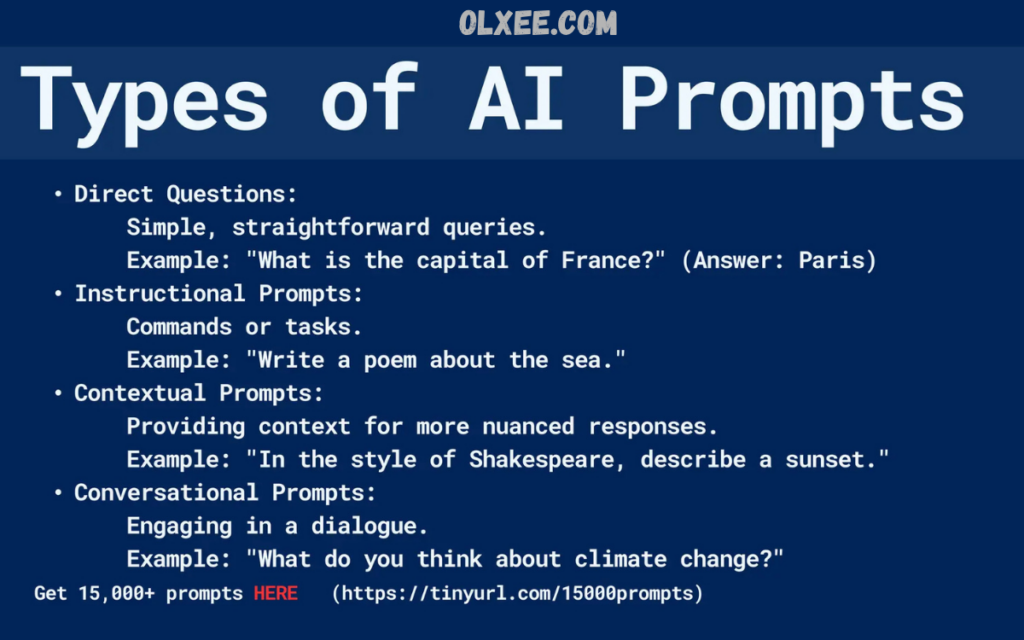
Different professional situations require different prompting techniques. Informational prompts request explanations, definitions, or educational content. Creative prompts encourage brainstorming, storytelling, marketing campaigns, or product ideas. Analytical prompts evaluate data, compare alternatives, identify trends, or summarize research findings. Instructional prompts generate step-by-step procedures, documentation, training materials, or operational guides.
Role-based prompts represent another highly effective category. These prompts instruct AI to respond from a specific professional perspective, such as a financial consultant, legal analyst, project manager, medical educator, or software engineer. Assigning a role helps AI adopt appropriate terminology, reasoning, and communication style, resulting in responses that better match professional expectations and industry standards.
Best Practices for Writing AI Prompts
Writing effective AI Prompts requires precision rather than complexity. Professionals should begin by defining the desired outcome before adding supporting details. Specific language eliminates confusion and improves consistency. Instead of requesting “write about cybersecurity,” a stronger prompt specifies the audience, purpose, structure, technical depth, and preferred writing style.
Breaking complex projects into smaller prompts also improves overall quality. Rather than requesting an entire business strategy in one instruction, professionals can ask AI to generate market research, competitor analysis, customer personas, implementation plans, and performance metrics separately.
Common Mistakes to Avoid
One of the most common mistakes involves writing vague or incomplete prompts. General requests often produce broad responses that lack depth or fail to address specific business needs. Without sufficient context, AI must make assumptions, increasing the likelihood of irrelevant or inaccurate information.
Another frequent mistake involves expecting AI to understand unstated requirements. Artificial intelligence cannot infer hidden intentions or organizational priorities unless explicitly stated. Failing to specify formatting preferences, audience characteristics, output length, or required sources may lead to additional revisions.
Read Also: Professional Property Investment Guide
AI Prompts Across Different Industries
AI Prompts support professionals across virtually every industry. Marketing teams use AI to generate campaign ideas, email sequences, social media content, product descriptions, customer personas, and SEO strategies. Human resource professionals create interview questions, onboarding documents, performance reviews, training materials, and employee communications with greater speed and consistency.
Software developers rely on AI Prompts for code generation, debugging assistance, technical documentation, API explanations, and workflow automation. Financial analysts summarize reports, evaluate investment scenarios, prepare executive presentations, and analyze trends. Healthcare professionals create patient education materials, administrative documentation, and medical summaries while maintaining appropriate human oversight and regulatory compliance.
Improving Productivity with AI Prompts
Professionals who integrate AI Prompts into daily workflows often experience significant productivity improvements. Routine administrative work, document drafting, meeting summaries, brainstorming sessions, research assistance, and content organization become faster without sacrificing quality.
Consistent prompt templates further improve efficiency by standardizing repetitive tasks. Organizations can develop reusable prompts for common business activities such as proposal writing, customer support responses, project planning, meeting agendas, and performance reporting.
The Future of AI Prompts

Future AI Promts
The importance of AI Prompts will continue expanding as artificial intelligence becomes more integrated into business operations. Future AI systems will support increasingly sophisticated conversations, multimodal interactions, and advanced workflow automation.
Prompt engineering will also become more collaborative and strategic. Organizations are likely to build internal prompt libraries, establish quality standards, and train employees to create optimized prompts for specialized business functions.
Frequently Asked Questions
What are AI Prompts?
AI Prompts are written instructions, questions, or commands provided to an artificial intelligence system to guide its response. A well-written prompt includes clear objectives, relevant context, and specific requirements, helping AI generate accurate, useful, and high-quality outputs for professional tasks.
Why are AI Prompts important?
AI Prompts are important because they determine the quality of AI-generated responses. Clear and detailed prompts improve accuracy, reduce misunderstandings, save time, and increase productivity. Professionals use AI Prompts to create reports, generate content, analyze data, automate workflows, and support decision-making.
How can I write better AI Prompts?
To write effective AI Prompts, clearly define your objective, provide sufficient context, specify the desired output format, identify the target audience, and include any limitations or examples. Reviewing and refining prompts based on previous responses also helps improve results over time.
Which industries benefit most from AI Prompts?
AI Prompts are valuable across many industries, including marketing, healthcare, education, finance, software development, human resources, legal services, customer support, and project management. Nearly every profession can use AI to improve efficiency and streamline repetitive tasks.
What is prompt engineering?
Prompt engineering is the process of designing and refining AI Prompts to generate accurate, relevant, and consistent responses from artificial intelligence systems. It combines clear communication, logical structure, and task-specific instructions to maximize AI performance.
Can AI Prompts improve business productivity?
Yes. AI Prompts help businesses automate routine tasks, generate documentation, summarize meetings, create marketing content, analyze information, and support strategic planning. Effective prompting reduces manual effort while allowing professionals to focus on higher-value work.
What are common mistakes when creating AI Prompts?
Common mistakes include using vague instructions, providing insufficient context, asking multiple unrelated questions in a single prompt, and failing to specify the desired format or audience. Avoiding these errors significantly improves the quality of AI-generated responses.
Are AI Prompts useful for beginners?
Absolutely. Beginners can start with simple, direct prompts and gradually learn advanced prompting techniques. As experience grows, adding context, examples, and formatting instructions leads to more accurate and professional results.
Conclusion
AI Prompts have evolved into a critical professional skill that influences the quality, accuracy, and usefulness of artificial intelligence outputs. Well-structured prompts improve communication with AI, reduce unnecessary revisions, enhance productivity, and support better business outcomes.
As artificial intelligence continues transforming modern workplaces, mastering AI Prompts will become increasingly valuable for professionals in every industry. Developing effective prompting habits enables individuals and organizations to unlock greater efficiency, creativity, and strategic value while maintaining the human expertise necessary for responsible decision-making.