
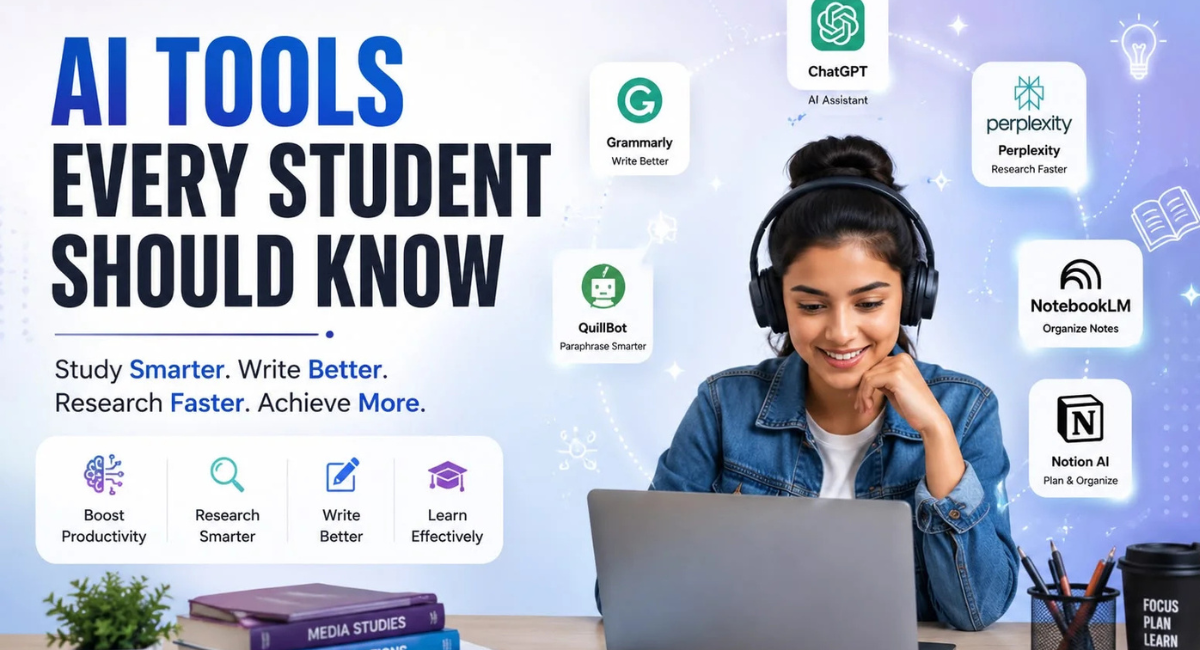
Best AI Tools for Students: Productivity, Learning, and Academic Success
Artificial intelligence has become a valuable part of modern education, helping students manage assignments, understand difficult subjects, organize study schedules, and improve writing skills. The best AI tools for students can reduce repetitive tasks and give learners more time to focus on understanding concepts and building academic skills.
AI-powered platforms can support productivity, learning, research, note-taking, writing, presentations, and exam preparation. When used responsibly, these technologies can become effective study assistants that complement traditional learning rather than replacing independent thinking.
Why Students Should Use AI Tools for Education
AI tools can help students handle multiple academic responsibilities more efficiently. From summarizing complicated information to creating study plans, AI can provide structured assistance that makes everyday academic tasks easier to manage.
Another important advantage is personalized learning. Students can ask questions, request explanations at different difficulty levels, practice concepts, and identify areas that need additional attention. This flexibility makes AI useful for different learning styles and academic subjects.
Best AI Tools for Students
The best AI tools for students cover different academic needs, including writing, research, productivity, studying, note-taking, mathematics, presentations, and language learning. Choose a tool based on the specific task rather than using one platform for everything.
Students should also consider accuracy, privacy, ease of use, available features, and educational value before selecting an AI tool. A useful AI assistant should help students understand and complete work more effectively while encouraging independent learning.
AI Tools for Productivity and Time Management
AI productivity tools can help students organize assignments, create schedules, prioritize tasks, and manage academic deadlines. Instead of manually planning every activity, students can use AI assistance to create practical study routines based on available time and academic priorities.
Productivity tools are particularly useful for students managing multiple subjects at once. A well-organized schedule can divide large assignments into smaller tasks, helping students maintain consistent progress and avoid unnecessary last-minute pressure.
AI Tools for Writing and Grammar Improvement
Writing assistants can help students improve grammar, spelling, sentence structure, clarity, and overall readability. These tools can identify common writing problems and suggest improvements that help students communicate ideas more effectively.
AI writing tools can also support brainstorming and outlining before students begin an assignment. Students should use these features as learning assistance rather than submitting AI-generated content as their own work when academic rules require original writing.
AI Tools for Research and Information Discovery
Research can become time-consuming when students need to understand unfamiliar topics or organize large amounts of information. AI research assistants can help explain concepts, identify important themes, summarize information, and create starting points for further investigation.
Students should verify important facts through reliable academic sources before using information in assignments. AI systems can occasionally provide incorrect, outdated, or incomplete information, so fact-checking is essential to responsible academic research.
AI Tools for Note-Taking and Summarization
AI note-taking tools can transform lengthy information into shorter, organized summaries. Students can use AI to identify important concepts, create revision notes, extract key points, and organize information from lectures or study materials.
Summarization is especially useful when preparing for examinations. Instead of reviewing every piece of information repeatedly, students can create concise study materials and return to the original content when they need deeper understanding.
AI Tools for Mathematics and Problem Solving
Mathematics students can benefit from AI tools that explain calculations and demonstrate problem-solving processes. These platforms can provide step-by-step assistance, making difficult mathematical concepts easier to understand.
Students should focus on understanding how a solution is reached rather than simply copying an answer. Using AI as an explanation tool can strengthen mathematical reasoning, while depending completely on automated answers may reduce opportunities for independent practice.
AI Tools for Presentations and Creative Projects
Creating presentations often requires research, organization, visual planning, and effective communication. AI-powered presentation tools can help students develop outlines, organize information, generate design ideas, and prepare content for academic presentations.
Creative AI tools can also support brainstorming for projects, posters, diagrams, and educational materials. Students should review generated content carefully and make their final projects reflect their own understanding, creativity, and academic requirements.
AI Tools for Language Learning
Students learning new languages can use AI for vocabulary practice, grammar explanations, conversation exercises, translation support, and writing feedback. AI can provide interactive practice that is useful outside traditional classroom sessions.
Language learners can also ask AI systems to create customized exercises based on their current ability. Regular practice with vocabulary, sentence construction, and conversational questions can help students build confidence while improving language skills.
AI Tools for Exam Preparation
AI can make exam preparation more structured by creating practice questions, flashcards, quizzes, summaries, and revision schedules. Students can provide a topic and ask for questions that test different levels of understanding.
Effective exam preparation should combine AI-generated practice with textbooks, class notes, teacher guidance, and independent problem-solving. AI can make revision more interactive, but students still need to evaluate their knowledge without assistance.
How AI Improves Student Productivity
One of AI’s biggest benefits is its ability to reduce repetitive academic tasks. Students can use AI to brainstorm ideas, organize notes, create study schedules, summarize information, and identify areas that require additional review.
Improved productivity does not simply mean completing more work quickly. True academic productivity involves using available time effectively while maintaining quality, understanding, and consistency. AI can support this process by helping students stay more organized.
Read Also: Houses for Sale: A Complete Guide to Finding the Right Home
How to Use AI Responsibly for Academic Success
Responsible AI use begins with understanding academic policies. Schools and universities may have different rules regarding AI-generated content, research assistance, editing, and assignment preparation. Students should always follow the requirements established by their institution or instructor.
Students should also protect personal information when using AI platforms. Avoid entering sensitive academic records, passwords, private documents, or confidential information into tools unless they offer appropriate security protections.
Benefits of AI Tools for Students
AI can provide personalized explanations, faster brainstorming, better organization, and convenient study assistance. Students can use these capabilities to approach difficult subjects from different perspectives and receive support when traditional study methods are not enough.
Another benefit is accessibility. AI tools can assist students with language difficulties, complex terminology, organization challenges, and different learning preferences. Used thoughtfully, AI can make educational resources more flexible and accessible.
Limitations of AI Tools in Education
AI tools are not perfect sources of information. They can generate inaccurate statements, misunderstand questions, produce incomplete explanations, or present information without sufficient context. Students should therefore treat AI output as assistance rather than unquestionable authority.
Another limitation is the possibility of overdependence. If students allow AI to complete every assignment, solve every problem, or write every response, they may miss important opportunities to develop critical thinking and communication skills.
Tips for Getting Better Results From AI Tools
Students should write clear and specific prompts when using AI. Including the subject, academic level, desired explanation style, and learning objective can produce more useful responses than asking vague questions.
It is also helpful to ask AI for explanations rather than only final answers. Questions such as “Explain this concept step by step” or “Give me practice questions without answers first” encourage active learning and make AI more useful as a study assistant.
How to Choose the Right AI Tool
The right AI tool depends on the student’s specific academic goal. A writing assistant may help with grammar and clarity, while a research assistant can organize information and a productivity platform can support schedules and task management.
Students should compare features, usability, privacy practices, limitations, and educational value before adopting a platform. Using a small collection of specialized tools can often be more effective than relying on numerous applications without a clear purpose.
AI and the Future of Student Learning
AI will likely continue changing how students study, research, write, and manage academic responsibilities. Future educational tools may provide increasingly personalized learning experiences based on individual progress, strengths, and areas requiring improvement.
However, technology will remain most effective when combined with human guidance and independent thinking. Teachers, textbooks, classroom discussions, practical experience, and collaboration continue to play important roles in meaningful education.
Frequently Asked Questions
What are the best AI tools for students?
The best AI tools depend on individual academic needs. Students can use different AI platforms for writing, research, productivity, note-taking, mathematics, presentations, language learning, and exam preparation.
Can AI tools help students study better?
Yes, AI tools can support studying by creating summaries, practice questions, flashcards, explanations, and personalized revision plans. Students should use these features to strengthen understanding, not replace independent study.
Can students use AI for academic writing?
AI can help with brainstorming, outlining, grammar, sentence clarity, and editing. However, students should follow their school’s academic policies and ensure submitted work meets requirements for original student contributions.
Are AI tools accurate for student research?
AI tools can provide useful research assistance, but they are not always accurate. Students should verify important claims, statistics, references, and factual information using reliable academic or authoritative sources.
Can AI create study schedules?
Yes, AI can help create study schedules based on subjects, available time, deadlines, and learning priorities. Students should adjust generated schedules according to their actual workload and personal study habits.
Can AI help with mathematics?
AI can explain mathematical concepts, demonstrate solution methods, and provide practice problems. Students should concentrate on understanding the reasoning behind solutions instead of relying entirely on automated answers.
Can AI help students prepare for exams?
AI can support exam preparation by generating quizzes, flashcards, practice questions, topic summaries, and revision plans. Combining AI practice with class materials and independent testing can create a stronger study routine.
Is using AI for schoolwork cheating?
Using AI is not automatically cheating, but rules differ by school, university, course, and assignment. Students should follow specific academic integrity policies and disclose AI use when required.
How can students use AI without becoming dependent on it?
Students should use AI for explanations, feedback, brainstorming, and practice while completing important reasoning and learning activities independently. Regular offline practice can help maintain critical thinking and subject knowledge.
What should students avoid when using AI tools?
Students should avoid blindly trusting AI-generated information, submitting prohibited AI-generated assignments, sharing sensitive personal information, and using AI as a complete replacement for learning. Verification and responsible use are essential.
Conclusion
The best AI tools for students can support productivity, learning, research, writing, organization, exam preparation, and academic development. When used correctly, AI can function as a flexible study assistant that helps students understand difficult concepts and manage academic responsibilities more efficiently.
Leave a Comment