

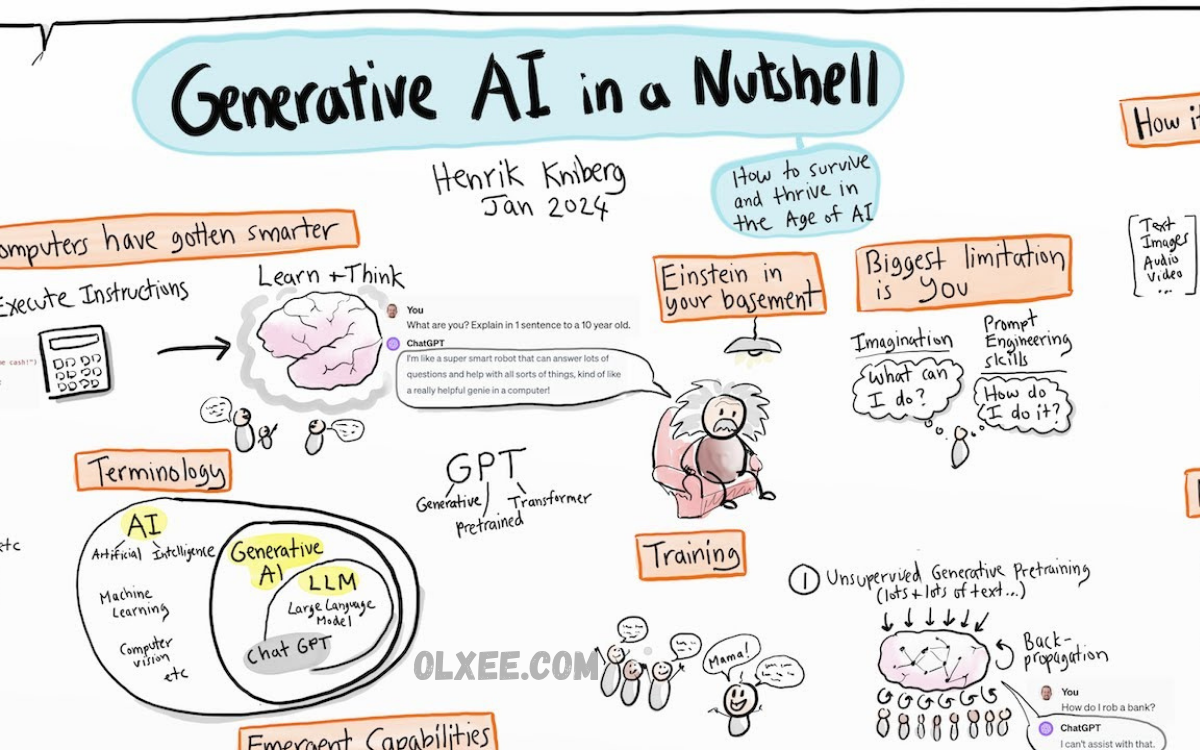
Artificial Intelligence (AI) has transformed the way businesses and individuals interact with technology. Among the most significant advancements in recent years is Generative AI, a branch of artificial intelligence capable of creating new content, including text, images, videos, audio, and code.
Generative AI is no longer a futuristic concept. It is already helping companies automate content creation, improve customer experiences, accelerate software development, and drive innovation across industries.
What Is Generative AI?
Generative AI refers to a category of artificial intelligence systems designed to create original content based on patterns learned from large datasets. Unlike traditional AI systems that primarily analyze data or make predictions, generative AI can generate entirely new outputs that resemble human-created content.
These systems learn from massive amounts of information, including text, images, videos, audio recordings, and programming code. After training, they can produce new content that follows similar structures, styles, and patterns found in their training data.
How Does Generative AI Work?
Generative AI operates through advanced machine learning techniques, particularly deep learning and neural networks. These models are trained on enormous datasets to identify patterns, relationships, and structures within the information they process.
When a user provides a prompt or instruction, the AI uses its learned knowledge to predict and generate the most relevant output. For example, if asked to write an article, the model analyzes language patterns and constructs coherent text based on the prompt provided.
The Role of Neural Networks
Neural networks are computational systems inspired by the human brain. They consist of interconnected layers of nodes that process information and learn from examples.
Through repeated training, these networks become increasingly accurate at understanding patterns and generating realistic outputs. The larger and more sophisticated the neural network, the more capable the AI system becomes.
Training Process
The training process involves exposing the AI model to vast amounts of data. During training, the system learns grammar, facts, visual elements, coding structures, and contextual relationships.
Once training is complete, the model can generate content by predicting what should come next based on the user’s input. This predictive capability forms the foundation of generative AI systems.
Read Also: Best AI Tools for Businesses in 2026: Top Solutions to Improve Productivity and Growth
Key Technologies Behind Generative AI
Several technologies contribute to the success of generative AI. These technologies work together to enable machines to understand, create, and refine content across multiple formats.
Among the most important innovations are deep learning architectures, transformer models, natural language processing (NLP), and large language models (LLMs). These advancements have significantly improved the quality and realism of AI-generated outputs.
Large Language Models (LLMs)
Large Language Models are AI systems trained on extensive text datasets. They can understand context, answer questions, summarize information, and generate human-like text.
LLMs power many modern AI applications, including virtual assistants, chatbots, writing tools, and coding assistants.
Transformer Architecture
Transformer architecture revolutionized AI development by enabling models to process and understand context more effectively.
This technology enables AI systems to analyze relationships among words, sentences, and concepts, resulting in more coherent and contextually relevant outputs.
Types of Content Generated by AI
One of the defining characteristics of generative AI is its ability to create multiple forms of content. This versatility makes it valuable across various industries and use cases.
Organizations use generative AI to produce everything from marketing materials and software code to artistic creations and educational resources.
Text Generation
AI can generate articles, blog posts, emails, reports, product descriptions, and conversational responses.
Businesses often use text-generation tools to improve productivity and streamline content creation workflows.
Image Generation
Generative AI can create realistic images, illustrations, digital artwork, and design concepts based on text descriptions.
This capability has transformed creative industries by enabling faster visualization and prototyping.
Audio and Music Creation
AI systems can generate speech, music compositions, sound effects, and voiceovers.
These applications are increasingly used in entertainment, education, and media production.
Video Generation
Modern generative AI tools can create animations, short videos, and visual presentations from text prompts.
As technology advances, AI-generated video content continues to improve in quality and realism.
Code Generation
Developers use AI coding assistants to generate code snippets, identify bugs, suggest improvements, and automate repetitive programming tasks.
This capability helps reduce development time and enhances software engineering productivity.
Benefits of Generative AI
Generative AI offers numerous advantages for businesses, creators, and consumers. Its ability to automate complex tasks and accelerate innovation makes it one of the most impactful technological developments of the digital age.
As adoption increases, organizations are discovering new ways to leverage AI for efficiency, creativity, and competitive advantage.
Increased Productivity
Generative AI can perform tasks that traditionally required significant human effort. This allows employees to focus on higher-value activities while AI handles repetitive content generation tasks.
The result is improved efficiency and faster project completion across various business functions.
Enhanced Creativity
AI serves as a creative partner by generating ideas, concepts, and drafts that users can refine further.
Rather than replacing human creativity, generative AI often enhances creative processes by providing inspiration and alternative perspectives.
Cost Savings
Automation reduces the time and resources required for content production, customer support, software development, and research activities.
Organizations can achieve significant operational efficiencies while maintaining quality standards.
Scalability
Generative AI enables businesses to create large volumes of content quickly and consistently.
This scalability is particularly valuable for marketing campaigns, e-commerce platforms, and global organizations serving diverse audiences.
Real-World Applications of Generative AI
Generative AI is already transforming numerous industries by enabling new capabilities and improving existing processes. Its practical applications continue to expand as technology evolves.
From healthcare and education to finance and entertainment, organizations are integrating generative AI into their workflows to gain strategic advantages.
Marketing and Content Creation
Marketers use AI to create blog posts, advertisements, social media content, email campaigns, and personalized messaging.
These tools help businesses produce content faster while maintaining consistency across communication channels.
Healthcare
Healthcare professionals use AI to assist with medical documentation, research analysis, drug discovery, and patient communication.
Generative AI can support decision-making processes, although human oversight remains essential in clinical settings.
Education
Educational institutions leverage AI for personalized learning materials, tutoring assistance, lesson planning, and content development.
Students can also benefit from AI-powered study tools that provide explanations and learning support.
Software Development
Developers use generative AI to write code, debug applications, generate documentation, and automate routine programming tasks.
This improves development efficiency and accelerates project delivery timelines.
Entertainment and Media
Content creators use AI to develop scripts, music, visual effects, animations, and interactive experiences.
The technology enables faster production while opening new opportunities for creative experimentation.
Challenges and Limitations of Generative AI
Despite its impressive capabilities, generative AI is not without challenges. Understanding these limitations is important for responsible adoption and effective implementation.
Organizations must carefully evaluate risks and establish appropriate governance frameworks when deploying AI solutions.
Accuracy and Hallucinations
Generative AI systems can occasionally produce inaccurate or misleading information. This phenomenon is often referred to as AI hallucination.
Users should verify important information generated by AI, especially in professional, medical, legal, or financial contexts.
Data Privacy Concerns
AI systems may process sensitive information during training or usage. Organizations must ensure compliance with privacy regulations and data protection standards.
Strong security practices are essential when implementing AI-powered solutions.
Bias and Fairness
AI models learn from existing data, which may contain biases. As a result, generated outputs can sometimes reflect or amplify those biases.
Developers and organizations must actively work to identify and mitigate fairness issues.
Intellectual Property Issues
Questions surrounding copyright, ownership, and content attribution continue to evolve as generative AI becomes more widespread.
Clear legal frameworks and ethical guidelines are necessary to address these concerns effectively.
The Future of Generative AI
The future of generative AI appears highly promising. Continued advancements in computing power, model architecture, and training techniques are expected to make AI systems even more capable and accessible.
As businesses increasingly integrate AI into their operations, generative AI is likely to become a standard tool for productivity, creativity, and innovation across industries.
Future developments may include more accurate models, improved multimodal capabilities, better personalization, stronger safety mechanisms, and deeper integration with everyday applications. While challenges remain, the technology’s potential to transform work and communication is substantial.
Frequently Asked Questions
What is generative AI in simple terms?
Generative AI is a type of artificial intelligence that can create new content such as text, images, videos, music, and code based on patterns learned from large datasets.
How is generative AI different from traditional AI?
Traditional AI typically analyzes data, identifies patterns, or makes predictions. Generative AI goes a step further by creating entirely new content rather than simply interpreting existing information.
What are some examples of generative AI?
Examples include AI chatbots, text generators, image-creation tools, music-generation platforms, video generators, and AI coding assistants.
Is generative AI safe to use?
Generative AI can be safe when used responsibly and with proper oversight. Users should verify important information and follow privacy and security best practices.
Can generative AI replace human jobs?
Generative AI can automate certain tasks, but it is more commonly used to augment human capabilities rather than fully replace workers. Many roles will evolve to incorporate AI-assisted workflows.
What industries benefit most from generative AI?
Industries such as healthcare, education, marketing, software development, finance, manufacturing, and entertainment are already benefiting from generative AI applications.
What is the future of generative AI?
The future of generative AI includes improved accuracy, greater personalization, advanced multimodal systems, stronger safety features, and broader adoption across industries worldwide.
Conclusion
Generative AI represents one of the most significant advancements in artificial intelligence. By enabling machines to create original content across multiple formats, it is transforming how individuals and organizations work, communicate, and innovate.
While challenges such as accuracy, bias, privacy, and intellectual property concerns must be addressed, the benefits of generative AI are substantial.
