
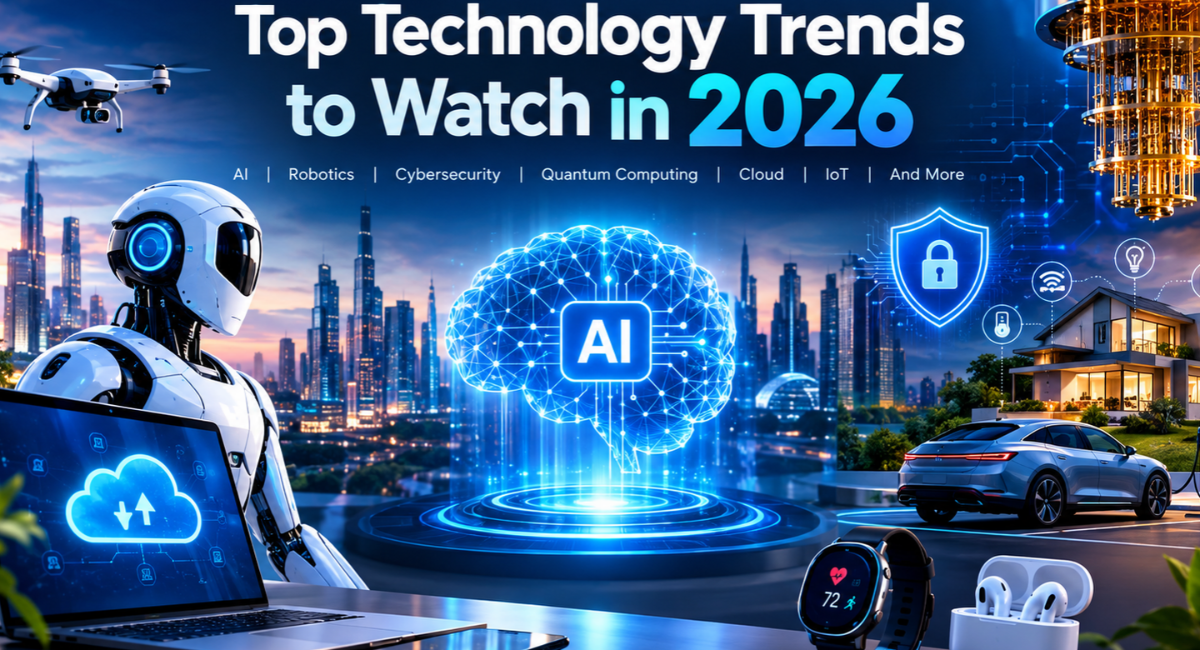
Technology Trends 2026: Key Innovations Shaping the Digital Future
Technology Trends 2026 are transforming how people work, communicate, create, shop, learn, and manage digital services. Artificial intelligence, advanced computing, robotics, cybersecurity, cloud platforms, connected devices, and emerging digital infrastructure are moving from experimental concepts into practical applications.
Businesses are increasingly adopting technologies that improve productivity, automate repetitive processes, strengthen security, personalize customer experiences, and support data-driven decisions. At the same time, consumers are gaining access to smarter smartphones, AI-powered applications, wearable devices, connected homes, and increasingly capable digital assistants.
Artificial intelligence remains one of the defining Technology Trends 2026. AI is moving beyond simple chatbots and experimental demonstrations toward systems capable of handling more complex workflows, analyzing information, generating content, assisting employees, and supporting business operations.
AI Agents Automate Digital Workflows
Generative AI is becoming increasingly integrated into professional software and consumer applications. Instead of existing as a separate tool, generative capabilities are increasingly appearing inside search systems, productivity platforms, design applications, coding environments, communication tools, and customer-service software.
Text generation remains important, but multimodal AI is expanding the range of possible applications. Modern systems can work with combinations of text, images, audio, video, and structured information, enabling richer interactions and more flexible digital workflows.
For businesses, generative AI can reduce the time required for drafting, research, ideation, documentation, translation, and content production. However, organizations still need quality-control processes because generated information can contain factual errors, inconsistent reasoning, or inappropriate outputs.
AI-Powered Search Changes Information Discovery
Search technology is also changing as AI becomes more deeply integrated into information discovery. Users increasingly expect search systems to understand conversational questions, combine information from multiple sources, and provide direct answers alongside traditional search results.
This development is changing how websites, publishers, brands, and businesses approach digital visibility. Content quality, factual accuracy, topical authority, useful structure, and clear information architecture are becoming increasingly important for online discovery.
AI-powered search does not necessarily eliminate traditional search behavior. Instead, search experiences can combine conventional results, summaries, direct answers, multimedia information, and interactive assistance. Businesses therefore need to consider both traditional search optimization and broader digital discoverability.
Robotics Moves Into Everyday Applications
Robotics is another important Technology Trends 2026 category. Advances in sensors, computer vision, machine learning, batteries, processors, and mechanical systems are helping robots perform increasingly sophisticated tasks.
Industrial robots are already widely used in manufacturing, but newer systems are expanding into logistics, warehouses, healthcare environments, agriculture, hospitality, and other operational settings. Robots can support repetitive or physically demanding activities while working alongside human employees.
Humanoid robotics is receiving particular attention because human-shaped systems may be able to operate in environments designed for people. Their practical deployment will depend on factors such as reliability, cost, safety, energy efficiency, maintenance, and the ability to perform useful tasks consistently.
Autonomous Systems Become More Capable
Autonomous systems use combinations of sensors, software, artificial intelligence, connectivity, and computing power to operate with limited human intervention. Autonomous vehicles, delivery systems, drones, warehouse equipment, and industrial machines are examples of this broader technological direction.
Progress in autonomous technology depends on more than AI models. Systems must understand physical environments, respond to unexpected conditions, communicate with other systems, and operate within safety requirements.
As autonomous technologies develop, industries will increasingly focus on specific use cases where automation can provide measurable benefits. Controlled environments such as warehouses, factories, ports, and designated transportation routes may offer practical opportunities for deployment.
Cybersecurity Becomes an AI-Era Priority
Cybersecurity is becoming more important as organizations depend on increasingly connected digital systems. Technology Trends 2026 include stronger security approaches designed to protect cloud platforms, applications, connected devices, identities, data, and AI systems.
Artificial intelligence can support cybersecurity by identifying unusual activity, analyzing large amounts of security data, detecting potential threats, and helping security teams prioritize incidents. At the same time, attackers can also use advanced technologies to automate malicious activity.
This creates an ongoing technological competition between defensive and offensive capabilities. Organizations therefore need layered security strategies that include strong authentication, access controls, software updates, monitoring, employee awareness, backup systems, and incident-response planning.
Zero Trust Security Gains Importance
Zero Trust architecture is becoming an important cybersecurity approach for modern organizations. Instead of automatically trusting users or devices because they are inside a particular network, Zero Trust emphasizes continuous verification and controlled access.
Cloud computing, remote work, mobile devices, third-party applications, and distributed infrastructure have made traditional network boundaries less meaningful. Employees may access business resources from multiple locations and devices, increasing the importance of identity-based security.
A Zero Trust strategy can include identity verification, least-privilege access, device security, segmentation, continuous monitoring, and detailed access policies. These controls can reduce unnecessary exposure when implemented appropriately.
Quantum Computing Continues Development
Quantum computing remains an important emerging technology. Unlike conventional computers, quantum computers use quantum-mechanical principles to process information in fundamentally different ways.
Quantum computing is still developing and is not a replacement for ordinary computers. Its potential lies in specialized problems where quantum algorithms could eventually provide significant advantages. Research areas include chemistry, materials science, optimization, cryptography, and scientific simulation.
Technology Trends 2026 will therefore include continued research into quantum hardware, error correction, algorithms, and practical applications. Businesses may increasingly explore quantum readiness even before large-scale commercial quantum computing becomes broadly available.
Read Also: Commercial Real Estate: A Professional Guide to Commercial Property
Cloud Computing Evolves Toward Intelligent Infrastructure
Cloud computing continues to provide the foundation for many digital services. Companies use cloud infrastructure for storage, applications, databases, artificial intelligence, analytics, development, collaboration, and large-scale computing.
The next stage of cloud development is increasingly connected with AI. Businesses need flexible computing resources capable of supporting demanding AI workloads, data processing, model deployment, and real-time applications.
Cloud environments are also becoming more distributed. Edge computing, hybrid infrastructure, and multi-cloud strategies can help organizations place computing resources closer to users, devices, and operational systems when latency, availability, or data requirements make that beneficial.
Edge Computing Supports Real-Time Applications
Edge computing moves processing closer to where data is generated. Instead of sending every piece of information to a distant data center, some processing can occur on local devices, gateways, or nearby infrastructure.
This can be useful for applications requiring fast responses, such as industrial automation, connected vehicles, smart cameras, healthcare equipment, and intelligent manufacturing systems.
Edge computing can also reduce the amount of data that needs to travel continuously across networks. When combined with cloud infrastructure, it creates a distributed computing model in which devices, edge locations, and centralized data centers work together.
5G Connectivity Supports Connected Experiences
5G networks continue to influence connected devices, mobile applications, industrial systems, and communications. Faster connections, improved responsiveness, and greater network capacity can support applications requiring reliable connectivity.
Businesses can use advanced connectivity for connected factories, logistics systems, remote monitoring, smart infrastructure, and large collections of Internet of Things devices. Consumers can benefit through improved mobile services and increasingly connected digital experiences.
The broader significance of 5G is therefore not limited to smartphone download speeds. Its importance also comes from its role as communication infrastructure for connected machines and services.
Wi-Fi Technology Continues to Improve
Wireless connectivity remains a critical part of modern digital infrastructure. Newer generations of Wi-Fi are designed to improve capacity, efficiency, reliability, and performance in environments containing many connected devices.
Homes, offices, schools, hotels, factories, and public spaces increasingly contain large numbers of smartphones, computers, televisions, sensors, appliances, and other connected products.
Better wireless technologies can help these environments handle growing device density. Combined with faster broadband and edge computing, advanced Wi-Fi can support increasingly responsive digital experiences.
Internet of Things Expands
The Internet of Things connects physical objects to digital networks. Sensors embedded in devices can collect information about location, temperature, movement, energy consumption, equipment condition, and other variables.
IoT technology is being used across manufacturing, agriculture, logistics, healthcare, retail, homes, and smart infrastructure. Connected systems can provide real-time information that helps organizations monitor assets and identify operational changes.
The next stage of IoT development will depend heavily on security, interoperability, battery efficiency, connectivity, and useful data analysis. Simply connecting more devices does not automatically create value; organizations need clear objectives for the information those devices generate.
Smart Homes Become More Intelligent
Smart-home technology is becoming more integrated as connected appliances, security systems, lighting, thermostats, entertainment devices, and home assistants communicate with one another.
Artificial intelligence can make smart-home systems more adaptive by recognizing patterns and helping automate routine activities. Users may increasingly interact with multiple devices through natural language rather than individual applications.
Security and privacy remain important considerations because smart-home devices can collect information about household activity. Strong account protection, software updates, network security, and careful device selection are important components of responsible smart-home adoption.
Wearable Technology Gets Smarter
Wearable devices continue to develop beyond basic notifications and fitness tracking. Smartwatches, earbuds, smart glasses, and other wearable products are increasingly incorporating sensors, computing capabilities, voice interaction, and AI-supported features.
Wearables can provide convenient access to information without requiring users to constantly interact with a smartphone. Smart glasses, in particular, represent an area where technology companies are exploring hands-free computing and augmented digital information.
Future wearable development will depend on battery life, comfort, privacy, processing power, connectivity, and practical everyday applications. Products need to provide useful experiences rather than simply adding technology to existing devices.
Augmented Reality and Mixed Reality Advance
Augmented reality overlays digital information onto the physical world, while mixed-reality systems can create more interactive combinations of physical and virtual environments.
These technologies have applications in gaming, education, training, engineering, retail, design, healthcare, and industrial operations. Workers can potentially access instructions, visualizations, or digital models while interacting with physical environments.
Hardware improvements, better displays, spatial computing, computer vision, and AI are contributing to more capable immersive systems. However, adoption will depend on cost, comfort, content availability, and whether these devices provide clear practical advantages.
Digital Twins Improve Real-World Operations
Digital twins are virtual representations of physical objects, systems, or environments. They can combine data from sensors, operational systems, simulations, and other information sources.
Manufacturers can use digital twins to monitor equipment, simulate changes, identify potential problems, and optimize processes. Cities and infrastructure operators can also use digital representations to understand complex systems.
As sensor networks and computing capabilities improve, digital twins can become increasingly detailed and dynamic. Their effectiveness depends on accurate data, reliable models, and clear operational objectives.
Sustainable Technology Gains Importance
Sustainability is becoming increasingly connected with technology development. Data centers, AI workloads, connected devices, electric transportation, industrial systems, and digital infrastructure all have energy and resource requirements.
Technology companies are therefore exploring more efficient processors, cooling systems, renewable energy integration, energy-management platforms, and hardware optimization. Efficient computing can reduce operational costs while supporting growing digital demand.
Sustainable technology also includes circular-economy approaches such as device repair, recycling, longer product lifecycles, and improved material use. Environmental considerations are increasingly becoming part of technology design and infrastructure planning.
Electric Vehicles Continue Digital Transformation
Electric vehicles combine transportation with software, sensors, connectivity, advanced batteries, and increasingly sophisticated driver-assistance systems.
Modern vehicles can receive software updates, monitor vehicle conditions, provide connected services, and integrate with mobile applications. Battery technology continues to influence vehicle range, charging time, cost, and overall performance.
Charging infrastructure is equally important. Wider deployment of charging networks, improved charging technology, and smarter energy management can influence the practical adoption of electric transportation.
Battery Technology Remains Critical
Battery development supports multiple Technology Trends 2026, including smartphones, laptops, electric vehicles, drones, robotics, wearables, and energy-storage systems.
Researchers and manufacturers continue to explore improvements in energy density, charging speed, durability, safety, manufacturing efficiency, and material use. Better batteries can make mobile and autonomous technologies more practical.
Battery innovation is particularly important because many emerging technologies depend on portable power. Robotics, electric transportation, and wearable computing all require efficient energy storage to operate effectively.
Digital Health Technology Expands
Healthcare is increasingly using digital technologies for administration, diagnostics, monitoring, communication, research, and personalized services. AI can help process medical information, analyze images, support research, and automate certain administrative tasks.
Wearable devices and connected medical equipment can also provide continuous or frequent information outside traditional healthcare environments. This can support monitoring and data collection when appropriately designed and clinically validated.
Healthcare technology requires particularly careful attention to privacy, security, accuracy, regulation, and human oversight. Digital tools should support healthcare professionals and patients while maintaining appropriate safeguards.
Personalized Education Uses AI
Education technology is another area affected by AI and digital platforms. AI-powered tools can provide personalized explanations, practice exercises, feedback, translation, and learning assistance.
Adaptive learning systems can adjust educational material according to a learner’s progress and needs. Teachers can also use technology for lesson preparation, assessment support, content creation, and administrative tasks.
However, education systems must consider academic integrity, privacy, accuracy, and the role of teachers. Technology can expand educational capabilities, but effective learning still depends on instructional quality and meaningful human interaction.
Privacy Technology Becomes More Important
As organizations collect and process increasing quantities of personal and operational data, privacy technology becomes a central component of digital infrastructure.
Privacy-enhancing technologies can help organizations limit unnecessary data exposure, protect sensitive information, and design systems that provide useful services without excessive data collection.
Consumers are also becoming more aware of how applications, websites, devices, and platforms collect information. Clear privacy controls and transparent data practices can become increasingly important factors in technology adoption.
The Future of Technology Trends 2026
Technology Trends 2026 show a broader movement toward intelligent, connected, automated, and increasingly personalized digital systems. Artificial intelligence is influencing many of these developments, but AI is only one part of a much larger technology ecosystem.
Cloud computing, edge infrastructure, robotics, cybersecurity, quantum research, connected devices, advanced batteries, immersive technologies, and sustainable infrastructure are developing alongside AI. Their combined progress can create new digital products and business models across many industries.
The most important technology developments will ultimately be determined by practical usefulness, affordability, reliability, security, regulation, and user adoption. Businesses and individuals that understand these factors can better evaluate emerging technologies and identify applications relevant to their needs.
Frequently Asked Questions
AI agents are software systems designed to perform multiple steps toward a defined objective. Depending on their configuration and permissions, they can analyze information, plan tasks, interact with applications, and complete workflows with varying levels of human supervision.
Robotics is expected to remain an important area of technology development, particularly across manufacturing, logistics, warehousing, healthcare, agriculture, and other environments where automated physical tasks can provide practical value.
What is the role of cybersecurity in Technology Trends 2026?
Cybersecurity protects increasingly connected systems, applications, devices, identities, and data. AI-powered threats and defenses make security an important consideration for organizations adopting new technologies.
Is quantum computing ready for everyday use?
Quantum computing remains an emerging technology. Current development focuses heavily on hardware, error correction, algorithms, and specialized applications rather than replacing conventional computers for everyday computing.
What is edge computing?
Edge computing processes some data closer to where it is generated instead of sending all information to centralized cloud infrastructure. This approach can support applications that require low latency or localized processing.
How will wearable technology change?
Wearable technology is becoming more capable through improved sensors, connectivity, computing, and AI. Smartwatches, earbuds, smart glasses, and other devices can provide increasingly personalized and hands-free digital experiences.
Why is sustainable technology important?
Sustainable technology focuses on improving energy efficiency, reducing resource consumption, extending hardware lifecycles, and supporting more responsible digital infrastructure. These considerations are increasingly relevant as computing demand grows.
What is the biggest technology trend in 2026?
There is no single technology that defines every market or industry. AI is a major area of development, while robotics, cybersecurity, cloud computing, connectivity, quantum research, immersive technology, and sustainable infrastructure are also significant parts of the Technology Trends 2026 landscape.
Conclusion
Trends 2026 represent a period of rapid development across artificial intelligence, automation, cybersecurity, cloud computing, robotics, connectivity, digital health, immersive technology, and smart devices. These technologies are increasingly moving from research environments into practical products and services.
The technology landscape will continue to evolve throughout 2026 and beyond. Rather than focusing on a single innovation, it is useful to understand how multiple technologies interact to create new capabilities. This broader perspective clarifies where digital technology is heading and how these developments may affect businesses, industries, and everyday life.
Leave a Comment