
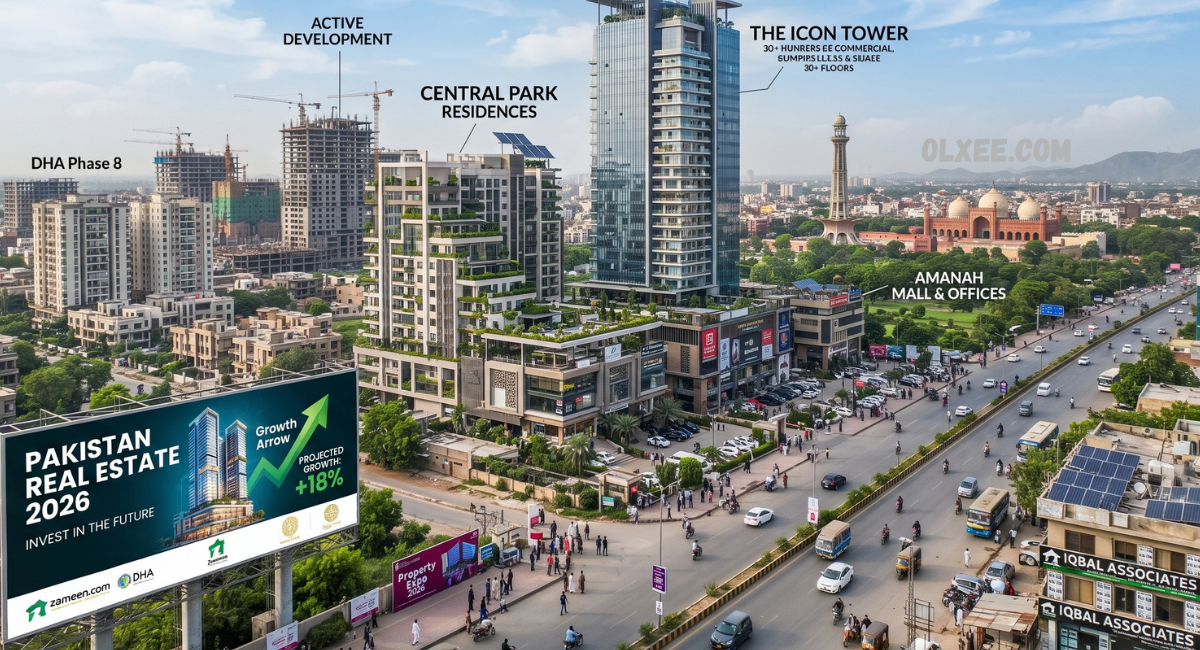
Real Estate in Pakistan 2026: Market Trends, Investment Opportunities, Prices, and Future Outlook
Real Estate in Pakistan 2026 remains an important part of the country’s economy, offering residential, commercial, retail, industrial, and mixed-use property opportunities. Population growth, urban expansion, infrastructure development, and changing housing needs continue to shape property demand across major cities.
The market is becoming increasingly diverse, with buyers considering apartments, houses, plots, commercial properties, gated communities, and rental investments. Economic conditions, financing costs, construction expenses, government policies, and local development projects can significantly influence property values and transaction activity.
Real Estate Market Trends in Pakistan 2026
One major real estate trend in Pakistan in 2026 is the growing preference for planned communities and modern residential developments. Buyers are paying greater attention to security, road access, utilities, schools, healthcare facilities, shopping areas, and community infrastructure when evaluating properties.
Digital property searches are also becoming more common. Buyers can research locations, compare listings, review property features, and communicate with agents through online platforms before visiting a property. This shift is making the property search process more convenient while increasing the importance of accurate property information.
Property Demand in Major Pakistani Cities
Property demand varies considerably between Pakistani cities because each market has different population patterns, employment opportunities, infrastructure, and development activity. Karachi has a large residential and commercial property market, while Lahore continues to experience expansion through housing schemes and urban development.
Islamabad and Rawalpindi also attract buyers interested in residential communities, apartments, commercial areas, and investment properties. Cities such as Faisalabad, Multan, Peshawar, and Gujranwala provide additional opportunities, particularly where population growth and local economic activity support new development.
Karachi Real Estate Market 2026
Karachi remains one of Pakistan’s largest real estate markets because of its population, business activity, employment opportunities, industrial base, and extensive urban area. Residential demand exists across multiple segments, including apartments, independent houses, residential plots, and gated communities.
Commercial property also plays an important role in Karachi. Offices, retail spaces, warehouses, and mixed-use developments can benefit from the city’s large consumer base and business ecosystem. However, investors should examine location, infrastructure, documentation, property condition, and rental demand before deciding.
Lahore Real Estate Market 2026
Lahore continues to attract interest in residential and commercial property because of its growing urban population, educational institutions, business districts, transportation networks, and housing developments. Planned communities have become an important part of the city’s property landscape.
Residential buyers often compare houses, apartments, plots, and developed properties based on accessibility and available facilities. Commercial investors may focus on areas with strong traffic, established businesses, offices, educational institutions, and growing residential populations.
Islamabad Real Estate Market 2026
Islamabad has a distinctive property market influenced by planned urban development, government institutions, educational facilities, diplomatic activity, and demand for organized residential communities. Buyers often consider houses, apartments, residential plots, and commercial properties in established and developing areas.
The surrounding Rawalpindi-Islamabad region provides a broader investment market. Infrastructure improvements and expanding residential communities can affect demand, but investors should distinguish between established locations and projects that remain dependent on future development.
Rawalpindi Real Estate Market 2026
Rawalpindi remains closely connected with Islamabad and provides residential and commercial opportunities across different price segments. The city includes established neighborhoods and expanding housing developments, offering options for both homeowners and property investors.
Connectivity between Rawalpindi and Islamabad is an important consideration when evaluating property. Locations with convenient access to major roads, public transportation, employment centers, educational institutions, and commercial areas can attract sustained residential demand.
Residential Real Estate in Pakistan 2026
Residential property remains one of the largest segments of Pakistan’s real estate market. Houses, apartments, villas, and residential plots meet different buyer needs, from personal housing to rental income and long-term investment.
Homebuyers increasingly evaluate more than property size and purchase price. Utilities, construction quality, security, parking, road access, neighborhood development, maintenance, and proximity to schools and healthcare services can all affect a residential property’s practical value.
Commercial Real Estate in Pakistan 2026
Commercial real estate includes offices, shops, retail centers, warehouses, business buildings, and mixed-use developments. Commercial properties can provide rental income, but their performance depends heavily on location, foot traffic, tenant demand, business activity, and surrounding development.
Investors should carefully compare advertised rental returns with actual market income. A commercial property with a high asking price may not necessarily provide strong cash flow if vacancy periods, maintenance expenses, taxes, service charges, or weak tenant demand reduce net returns.
Apartment Market in Pakistan
Apartments are becoming increasingly relevant in large urban centers where land prices, population density, and changing lifestyles influence housing preferences. Apartments can offer access to central locations and shared facilities without requiring buyers to purchase large plots.
The apartment market includes luxury developments, mid-range projects, and smaller, affordable units. Buyers should investigate project approvals, developer history, construction progress, possession terms, maintenance arrangements, parking provisions, and ownership documentation before purchasing.
Residential Plot Investment
Residential plots remain popular among Pakistani investors because they provide flexibility for future construction. Buyers may purchase plots for personal homes, future development, or long-term holding depending on their financial objectives.
Plot investment requires careful examination of development status and legal documentation. Buyers should verify ownership records, approval status, possession conditions, development charges, access roads, utilities, and transfer procedures rather than relying solely on projected future prices.
Rental Property Investment in Pakistan
Rental property can provide recurring income while allowing investors to retain ownership of the underlying asset. Houses, apartments, shops, offices, and warehouses can all generate rental income when located in areas with consistent tenant demand.
Rental investment requires analysis of gross and net returns. Investors should consider purchase price, expected rent, vacancy periods, maintenance costs, taxes, service charges, property management expenses, and potential repair needs when calculating a property’s actual return.
Property Prices in Pakistan 2026
Property prices in Pakistan vary significantly by city, neighborhood, property type, size, development stage, and infrastructure quality. There is no single national price that accurately represents the entire real estate market in Pakistan in 2026.
Buyers should compare multiple recent listings and, where possible, actual transaction information before estimating market value. A property located near established commercial areas or major infrastructure may have a substantially different valuation from a similar-sized property in a developing location.
Factors Affecting Property Prices
Location remains one of the most important factors affecting property values. Accessibility, road networks, public transportation, nearby commercial areas, schools, hospitals, employment centers, and neighborhood development can influence both demand and pricing.
Economic conditions also affect the real estate market. Interest rates, inflation, construction costs, household income, credit availability, taxation, and investor confidence can change purchasing behavior. Property prices may therefore move differently across cities and market segments.
Real Estate Investment Opportunities
Real estate investment opportunities in Pakistan in 2026 span residential, commercial, industrial, rental, and development-focused properties. Investors can select different strategies depending on capital availability, investment horizon, risk tolerance, and desired liquidity.
Some investors prefer rental income, while others focus on long-term capital appreciation or property development. Each strategy has different requirements, costs, and risks, so investors should define their objective before selecting a property rather than purchasing based only on short-term market expectations.
Real Estate Investment for Beginners
New investors should start with a clear budget and a basic understanding of the local property market. Researching several locations can reveal differences in purchase prices, rental demand, development quality, infrastructure, and resale activity.
Beginners should also avoid making decisions solely from promotional claims. Before committing substantial funds, independently verify property documents, ownership status, approvals, possession information, development progress, and market comparables.
Importance of Location
Location remains central to property investment. Two properties with similar sizes and construction quality can have very different values because of differences in accessibility, neighborhood development, commercial activity, and surrounding infrastructure.
Investors should evaluate both current conditions and realistic development plans. A developing area may offer lower entry prices but can involve longer waiting periods and greater uncertainty than an established neighborhood with existing infrastructure and active property transactions.
Legal Verification Before Buying Property
Legal verification is essential when purchasing property in Pakistan. Buyers should confirm ownership, title documents, approved layouts, applicable development permissions, transfer requirements, outstanding charges, and any restrictions affecting the property.
Professional legal and property verification can reduce the risk of disputes and documentation problems. Buyers should avoid transferring substantial funds before completing appropriate due diligence and confirming that the seller has the legal authority to transfer the property.
Property Documentation in Pakistan
Property documentation can include ownership records, sale agreements, allotment or transfer documents, development approvals, possession documentation, and other records depending on the property and jurisdiction. Requirements can differ by location and authority.
Buyers should ensure property records match the property being purchased. Carefully check names, plot numbers, measurements, boundaries, ownership information, and payment records before completing the transaction.
Real Estate Taxes and Costs
Real estate transactions can involve several costs beyond the advertised property price. Depending on the transaction and applicable rules, buyers and sellers may encounter taxes, registration charges, transfer fees, development charges, agent commissions, documentation expenses, and other costs.
Tax rules and property-related charges can change over time. Investors should confirm current requirements with the relevant authorities or a qualified tax professional before completing a transaction, because an outdated cost estimate can materially change the total investment required.
Role of Interest Rates
Interest rates can influence real estate demand by affecting borrowing costs and household purchasing power. When financing becomes more expensive, some buyers may delay purchases or reduce their budgets, while cash buyers may become relatively more active.
The relationship between interest rates and property prices is not identical across every Pakistani market. Local supply, rental demand, construction costs, economic activity, and investor behavior can also affect property transactions and valuations.
Construction Costs and Property Development
Construction costs matter for both developers and individual homeowners. Prices of cement, steel, labor, electrical equipment, plumbing materials, finishing products, and other inputs can influence the final cost of building a property.
Higher construction costs can affect the pricing of newly developed houses and apartments. Buyers comparing a constructed property with a vacant plot should therefore consider not only land value but also replacement costs, construction quality, age, maintenance requirements, and remaining useful life.
Gated Communities and Housing Societies
Gated communities remain attractive to many buyers because they can provide planned roads, security arrangements, utilities, parks, community facilities, and organized residential layouts. However, facilities and development standards differ significantly between projects.
Before buying in a housing society, buyers should check the relevant approval status, developer information, infrastructure progress, possession status, utility availability, and the transfer process. Marketing material should not replace independent verification of project conditions.
Overseas Pakistanis and Real Estate
Overseas Pakistanis are an important potential buyer segment because property ownership can connect them to Pakistan and support family housing or investment objectives. Remote purchasing, however, creates additional requirements for verification and transaction management.
Overseas buyers should use reliable legal representatives and verify property documentation through appropriate official channels. Clear authorization, transparent payment records, independent inspections, and secure transfer procedures can help reduce risks associated with remote transactions.
Technology and Digital Real Estate Services
Technology is changing how buyers discover and evaluate properties. Online listings, digital maps, virtual tours, property comparison tools, and electronic communication let prospective buyers do preliminary research before visiting locations.
Digital tools can improve convenience, but buyers should still verify online information. Listing prices may not reflect final transaction values, and photographs and descriptions may not fully convey property condition, neighborhood infrastructure, or legal status.
Risks of Real Estate Investment
Real estate investment carries risks including market-price changes, weak rental demand, legal disputes, documentation problems, delayed development, construction issues, liquidity constraints, and unexpected ownership costs. These risks can vary substantially by location and property type.
Investors should consider how easily a property could be sold if circumstances change. A property that appears attractive on paper may take longer to sell if demand is limited. Maintaining financial reserves can also help investors manage taxes, repairs, vacancies, and other unexpected expenses.
Common Real Estate Mistakes
One common mistake is purchasing property based solely on expected future price increases. Development promises, market rumors, and promotional claims should not be treated as guaranteed outcomes because property markets can change with economic and regulatory conditions.
Another mistake is ignoring total ownership costs. Investors should calculate the complete financial requirement, including purchase expenses, taxes, transfer costs, maintenance, financing, renovation, and potential vacancy. A realistic financial model provides a clearer picture of the investment.
How to Choose Property in Pakistan
Choosing property begins with identifying the purpose of the purchase. A family seeking a home may prioritize schools, healthcare, commuting distance, security, and community facilities, while a rental investor may focus more heavily on tenant demand and net rental yield.
After defining the objective, buyers can compare locations and properties using consistent criteria. Before making a final decision, consider price per unit area, development status, accessibility, legal documentation, rental potential, resale activity, and future infrastructure.
Future of Real Estate in Pakistan 2026
The future of Real Estate in Pakistan 2026 will depend on several interconnected factors, including urbanization, population growth, household formation, economic conditions, construction activity, infrastructure investment, financing availability, and government policies.
Demand is likely to remain diverse because Pakistan has large urban populations and continuing housing requirements. However, individual property markets can behave differently, so location-specific research is essential to understand future opportunities and risks.
Real Estate Investment Strategy
A structured investment strategy can help investors manage uncertainty. Investors may divide their research into location analysis, property valuation, legal verification, financing requirements, rental assessment, development status, and exit planning.
Investors should also establish an investment horizon before purchasing. Short-term trading, long-term holding, rental investment, and construction-based strategies require different levels of capital, patience, management, and risk assessment.
Real Estate Market Research
Reliable market research should combine multiple information sources rather than depending on a single property listing or agent. Buyers can compare asking prices, recent transaction information where available, rental rates, development activity, infrastructure, and comparable properties.
Local knowledge can also be valuable because neighborhood-level conditions can differ considerably. A major road, commercial development, transportation project, or utility improvement can affect nearby property demand differently depending on access and surrounding land use.
Sustainable Real Estate Development
Sustainable development is becoming increasingly relevant to modern property planning. Energy-efficient buildings, better ventilation, efficient water systems, green spaces, waste management, and climate-conscious construction can improve long-term usability.
For homeowners and investors, sustainability can also influence operating expenses and property appeal. Buildings designed for efficient energy and resource use may offer practical advantages, although the benefits depend on construction quality, local climate, maintenance, and actual building performance.
Real Estate and Urban Development
Urban development continues to shape property markets as cities expand outward and existing areas become denser. New roads, transportation links, commercial districts, educational institutions, and healthcare facilities can influence the attractiveness of surrounding locations.
However, investors should distinguish announced infrastructure from completed infrastructure. Investors should examine project timelines, current construction status, funding conditions, and actual accessibility before assigning significant value to expected future developments.
Is Real Estate a Long-Term Investment?
Real estate can be used as a long-term investment strategy, but results are not guaranteed. Property values and rental income can rise or decline depending on economic conditions, location-specific demand, regulations, development quality, and broader market conditions.
Long-term investors should therefore focus on fundamentals rather than relying entirely on short-term price movements. Strong documentation, useful locations, sustainable rental demand, reasonable acquisition costs, and manageable ownership expenses can form important parts of a long-term property strategy.
Frequently Asked Questions
What is Real Estate in Pakistan 2026?
Real Estate in Pakistan 2026 refers to the country’s residential, commercial, industrial, rental, and development property market during 2026. Market conditions differ by city, location, property type, and economic factors.
Which city has a major real estate market in Pakistan?
Karachi, Lahore, Islamabad, and Rawalpindi have major and diverse property markets. Other cities, including Faisalabad, Multan, Peshawar, and Gujranwala, also have active real estate sectors.
Is property investment suitable for beginners?
Beginners can consider property investment after researching their budget, objectives, location, legal documentation, rental demand, and total ownership costs. Professional verification can help identify potential documentation and transaction risks.
What affects property prices in Pakistan?
Location, infrastructure, population growth, economic conditions, construction costs, financing conditions, rental demand, development status, taxation, and market activity can influence property prices.
Are residential plots still important in Pakistan?
Residential plots remain an important property category because buyers can hold land for future construction or development. However, buyers should carefully verify development status, legal documentation, possession, utilities, and location.
What should buyers check before purchasing property?
Buyers should check ownership records, title documentation, approvals, property measurements, possession status, outstanding charges, development conditions, transfer procedures, and applicable taxes and fees.
Is rental property a good investment strategy?
Rental property can generate recurring income, but returns depend on purchase price, rent, occupancy, maintenance, taxes, management costs, and local tenant demand. Calculate net income before investing.
What is the role of location in real estate?
Location can strongly influence property demand and value. Accessibility, transportation, schools, healthcare, commercial activity, employment centers, utilities, and neighborhood development can all affect property attractiveness.
How can overseas Pakistanis invest in property?
Overseas Pakistanis can research suitable properties and use appropriate legal and transaction representatives. Independent documentation checks, secure payment procedures, authorization, and verification are particularly important for remote purchases.
What is the future of Pakistan’s real estate market?
The future will depend on urbanization, population growth, housing requirements, infrastructure, economic conditions, construction costs, financing availability, regulations, and local market demand. Individual property markets may perform differently.
Conclusion
Real Estate in Pakistan 2026 offers a broad market covering residential properties, apartments, plots, commercial buildings, rental assets, industrial properties, and planned communities. Major cities such as Karachi, Lahore, Islamabad, and Rawalpindi continue to provide diverse property markets, while other urban centers also present location-specific opportunities.
Successful property decisions require more than identifying a popular area or attractive price. Buyers and investors should evaluate location, documentation, development status, total costs, rental demand, infrastructure, financing conditions, and investment objectives before committing capital. Careful research and professional verification remain essential throughout the property-buying process.
Leave a Comment